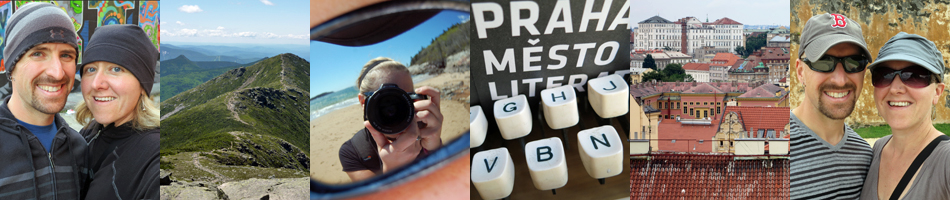
Putting Charlottesville to the Test
We started our day today just outside of Charlottesville, VA (C’Ville) at Thomas Jefferson’s famous home, Monticello. The rain held off as we walked through the gardens and took in the view. As we toured the home itself, the place that Jefferson loved more than any other, a quote from Jefferson about his home struck me. “I am as happy nowhere else and in no other society, and all my wishes end, where I hope my days will end, at Monticello.” This is how I want to feel about the place that I live, at least most of the time. It should be enriching and inspiring, while providing a venue for both the social and recreational activities I enjoy. I don’t think that’s too much to ask.

Scenes from Monticello (L to R): J in the Garden Pavilion, extensive vegetable gardens, the main house, gravestones with a story and a view
In addition to exploring ourselves, the United States and the National Parks, one goal of our road trips has been to seek out places that we someday may want to live. Each new city or town we enter goes through a review process either openly or in our minds. All locations are ultimately compared to the New Hampshire Seacoast. Why the Seacoast? Aside from it being our current home and a familiar place, it has several characteristics that we look for in a home base: Not too crowded and not too rural (our ideal is somewhere between 8,000 and 100,000 people), great places too run (long roads with low traffic, low risk of crime, beaches and/or bike trails), an arts/music/literary scene, and a downtown with quality independent restaurants and coffee shops. Our current hometown has most of these characteristics, but given our recent freedom, we enjoy entertaining the idea of moving to new places.
One mistake we’ve made during our travels is to build up new places in our minds before actually visiting them. No town is perfect, and unrealistic expectations can ruin a place before even getting there. The first example of this for us was Portland, Oregon. We had built Portland up to be the ideal place to live: progressive, artsy, West Coast (sort of)…it sounded perfect. When we arrived in Portland, it was raining, gray, cold, filled with homeless people and nothing like the place we wanted it to be. Although we eventually grew to like Portland, we were disappointed by its inability to live up to our escapist/utopian expectations. It’s easy to overlook the flaws in one’s hometown. They are familiar, which by nature makes them less threatening. The flaws in a new place stand out, especially when you haven’t imagined there would be any.
Before we came to Virginia, a friend recommended that we check out Charlottesville, home to the University of Virginia. “You’ll like it,” she assured us. We asked our host, B, about it, and he concurred, mentioning the pedestrian mall, Friday night live music, yummy pizza, etc. as highlights. Despite the threat of severe storms, we left Monticello and continued to downtown C’ville, anxious to give it a look before we headed out of Virginia for a few more stops on this leg of our journey.
We started our visit with a walk hand-in-hand down the pedestrian mall, taking in the mix of independent and chain stores, shops and restaurants. So far, so good. We stopped at the most highly recommended pizza joint in town, Christian’s, for a slice and a local beer. Lots of veggie options and definitely delicious! We sat by the window and enjoyed our late lunch while watching the eclectic mix of passers-by: business people, students, children, grandparents and homeless folks, and they all seemed right at home in this downtown center. It’s a welcoming place.
After lunch, we waited out a downpour in a used bookstore called Blue Whale Books. We chatted with the cashier, a UVA poet, and picked up two used books for $2 (a biography of Rilke for J and an analysis comparing Jungian philosophy to Tibetan Buddhism for me). We left the pedestrian mall and headed for a drive around the UVA campus where the academic buildings were right across the street from the coffee shops and pubs…my kind of town.

Snapshots of C’Ville (L to R): Orienting ourselves on Main Street, the rainy pedestrian mall, tasty pizza and beer, and the UVA campus
The final test for C’Ville, and any town, was the grocery store. As vegetarians who do our best to cook and eat healthy, local, organic food whenever possible, the quality of the grocery store is a key factor in determining the livability of a city or town. When it comes to grocery stores, a town with a Whole Foods is pretty much a sure thing. With the exception of higher prices, Whole Foods is like a candy store for vegetarians. It’s a place to buy the specialty items that most grocery stores don’t carry. Tack on a weekly supplemental trip to a regular grocery store for staples and a farmer’s market for seasonal items, and you’ve got everything you need. The C’Ville Whole Foods was clean, bustling and close to downtown, rounding out the Words Per Gallon livability checklist.
So how did C’Ville stack up? We could definitely see ourselves living there. For now though, there are so many other towns to explore, more roads to run on and more National Parks to visit. Plus, our new place on the Seacoast beckons; it will be ready later this summer. Maybe we’ll move next year… -M
Modern Self-Reliance

L to R: Storm clouds rolling in, M clearing debris by the fallen tree, this morning’s aftermath
During these early days of our journey, I’ve spent more time being active and less time relaxing than I thought I would. Although I love reading, it’s hard to curl up with a good book when there is a mountain to climb or a town to explore or a recipe to invent. This week I finally managed to spend a few evenings reconnecting with the likes of Thoreau and Emerson. I laughed out loud rereading the introduction of Walden two nights ago, pleasantly surprised (again) by the relevance of some of his statements 150+ years after he wrote them.
Thoreau’s contemporary, Emerson, had a few relevant passages of his own in the 1841 sleeper Self-Reliance, which I’ve also flipped through recently. To Emerson, self-reliance meant things like individualism and non-conformity and authentic inconsistency. To me, this week anyway, self-reliance means problem-solving even when we don’t have complete information. It means knowing how to read a map (and further, actually possessing one) when we’re off the grid and GPS can’t help us. It means getting creative with where and how we workout when our usual running routes are hundreds of miles away. And last night, it meant summoning all of my introverted courage to make a cold call to a person I’d never met asking them to help me.
Why did I need a stranger’s help? First, let’s back up to last week, before our friend left town. Just before heading to the airport, B filled us in on some need-to-know info about the house, practical stuff like where to find dry firewood and where to drop off the recycling. He also mentioned the closest neighbors, Mr. and Mrs. H, saying he wished he had time to introduce us to them before he left, but alas, that hadn’t worked out. So instead, we just got a passing reference to their existence, at which point for whatever reason, I catalogued their names in my brain.
There are only five houses on this gravel road, all set back into the woods and separated from each other by 1/3-mile sections of forest. We pass three driveways on the way to B’s house, but we can barely see the houses, and we’ve never seen another car on the one-lane road. Mr. and Mrs. H live just past B’s house, but we can’t see their house either. Occasionally we hear car wheels crunching over the gravel. Most folks in the area keep to themselves, and it was unlikely we’d run into any of the neighbors during our stay.
Then last night, after two days of self-imposed exile on the mountain, M and I headed into town for dinner. We knew a line of thunderstorms was pushing through the area, but we weren’t too worried. Rain’s rain. We made it to dinner and almost back to the house before the first drops hit the car. We assumed the storm was just arriving. Then we noticed several branches and clusters of leaves on the road ahead of us. “Looks like the storm already blew through here,” M commented.
We continued toward the house, through the series of dips and turns, before stopping to remove a large branch from the road in front of us. Only after getting out of the car did we notice a giant tree down, blocking the entire road, about fifty feet ahead of where we stopped. We walked closer to inspect things. There was no way around the tree, no lights visible at the nearest neighbor’s house, and the rain was picking up. The storm was just getting started.
We decided to back track to the main road where the tree cover was less dense, thinking that if one giant tree could fall, so could another. We drove the five miles or so back into town and waited out the storm in a pharmacy parking lot (where there was cell service). As rain pelted the car, we contemplated our options. We could drive back to the tree, park the car, and walk (in flip-flops, of course) the remaining half-mile to the house to pick up B’s chainsaw, which (a) he warned us wasn’t top notch and (b) neither of us had used before. We could find a map and see if we could locate an alternate route to the house, perhaps on a connecting back road. Or we could try to flag down one of the neighbors for help.
For context, at my core, I am slightly awkward introvert who can go weeks happily without interacting with another human. So the idea of blindly ringing someone’s doorbell is a paralyzing thought. Making a cold telephone call is a close second, but it beats the in-person interaction. So from the depths of my brain, I recalled Mr. and Mrs. H’s name and used the internet connection on my phone to look up their telephone number. There were eight H’s in town, but only one on the right road. With that find, I summoned all of my introverted courage and dialed the number.
After a mildly strange introduction to the tune of “we’ve never met, but I’m staying at the house next door and is there any chance you know of another way into the neighborhood because there is a giant tree blocking the road and we can’t get home.” Mrs. H, who answered the phone, wasted no time in understanding my rapid Yankee speech and said, why, yes, there was a back road, but she wasn’t sure what condition it was in and the car might get all scratched up if we attempted to use it. After a minute more of conversation and a brief chat with her husband, Mrs. H said that Mr. H would grab his chainsaw and meet us by the tree in a few minutes. Sweet relief!
By the time we arrived back at the tree, Mr. H was busy at work. We left the headlights of our car on to shed some light on the situation. Mr. H quieted the chainsaw when we got out of our car and approached him. “You said it was a tree, but I had no idea it was going to be this big of a tree!” he said with a laugh. We exchanged handshakes and greetings and then looked up and up, to about 30 feet off the ground where it looked like lightning struck. Half the tree was still standing, splintered at its wounded top, and the other half—an additional thirty feet or so of it—was on the ground, blocking the road from side to side.
After another minute of talk about the weather and how we knew B, Mr. H got back to work, cutting off branches and limbs before tackling the thin upper part of the tree. While he figured out the best way to fillet the thick main trunk of the tree, M and I got down to work, moving the parts and pieces and stumps and logs to either side of the gravel road.
The whole task took about 15 minutes, a feat only possible because of Mr. H’s chainsaw. As it turned out, Mr. H was grateful he found out about the tree on a Tuesday evening and not on Wednesday morning as he was leaving for work or his kids were trying to get to school. He would have had to do the work either way, and better to know about it in advance and have a little help. We were grateful for his help and his power tools. Sometimes self-reliance means wielding the chainsaw yourself, and other times it means calling someone with a bigger chainsaw to help you. -J
From Farm to Table…via Lynchburg
Our Virginia adventures continued yesterday with a day trip into Lynchburg. A few weeks ago, while still back in New Hampshire, we had sought out and registered for a 10K race downtown. We have a goal of running a race every month this year, and due to our travels, a Virginia race best fit our schedule for May. Neither of us had been to Lynchburg before, and running the race was a great way to see part of the city. (You can read my full recap here if you’re interested…)
After the race, which had an early 8 AM start, we did a quick change of clothes at the car (tucked into a shady spot in a free parking garage) and walked several blocks down Main Street to the Lynchburg Community Market. We planned to fill a bag with fresh local produce, but first things first…specifically, breakfast. We assumed the long line at Barb’s Dream Hut inside the marketplace was a good sign, so we ordered veggie omelets and shared a side of hash browns. We also ended up sharing our table with a local couple in their late 70s. They were newlyweds, having just tied the knot last December, although their first date was actually 63 years earlier, before he introduced her to his best friend…whom she subsequently married. It was a sweet story and part of a lovely conversation.
After breakfast, we wandered around the indoor market, picking up some Vidalia relish and locally roasted coffee before hitting up the farm stalls outside. We loaded two shopping bags with onions, peppers, squash, cabbage, beets, sweet potatoes, and kale, plus a loaf of fresh bread and a tub of sun-dried tomato goat cheese. As is typical for farmers markets, we paid a lower-than-usual price for produce fresh from the producers’ trucks and a higher-than-usual price for artisan breads and cheeses. For us, this is a fair trade-off, allowing us to support the local economy (wherever we are) and satisfy our own desires to know what we are eating and how it was made.
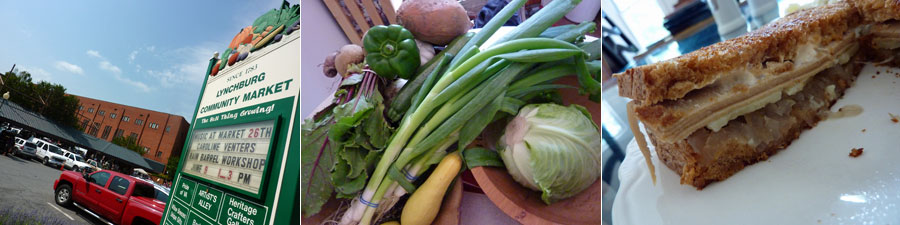
L to R: Lynchburg Community Market, the day’s bounty, grilled deliciousness
We left the market and walked back to the car, stashing our goods before driving over to the Old City Cemetery. The cemetery is more than a burial ground, as it contains five small museums paying homage to Lynchburg’s role in the Civil War and the railroad’s role in Lynchburg’s history. Lynchburg’s location on the James River and at the convergence of three major railways led to its establishment as a major hospital site during the Civil War. The cemetery is filled with history, including the graves of more than 2,200 Confederate soldiers and numerous early cultural and political leaders from the region.
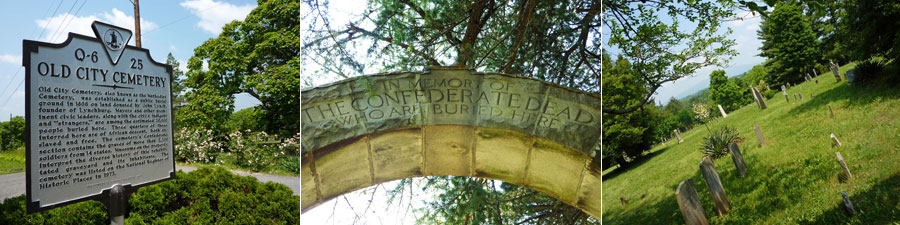
L to R: Historical marker, engraved arch, serene grounds
Our next and final stop in town was the Anne Spencer House for a visit to her garden. Spencer was a poet and part of the Harlem Renaissance of the 1920s. Her house is part of the Pierce Street historic district (one of seven historic districts in Lynchburg), and the garden has been lovingly restored by a local non-profit group. It is open to the public from dawn to dusk, and we found ourselves alone there on a sunny Saturday afternoon. We wandered the garden paths and sat in chairs outside Edankraal, the writing cottage her husband built for her so she would have a quiet place to write and be inspired by the beauty of the garden. The garden is filled with history, both in the stories of significant visitors that stayed there and in the plants and flowers in the garden, many of which have persisted since the Spencers first planted them in the 1930s and 1940s.
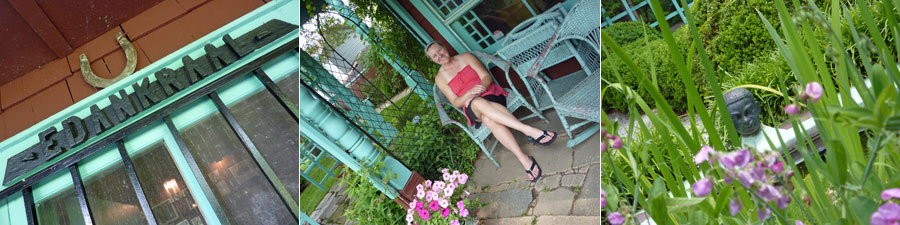
L to R: Cottage signage, J on the porch, garden fountain (gift from W. E. B. DuBois)
On the way home, we talked about how we would love to have a cottage like Edankraal someday, a quiet place for writing and possibly for living. For now, we are getting used to writing and living wherever we find ourselves, which this week is at our friend’s mountain retreat. After the short drive back there, we unloaded our bounty and got down to the business of making the most amazing grilled sandwiches using the fresh bread, onion relish and goat cheese. We capped the day by heading up to the second-story deck to watch the sun set over the mountains, thankful for a perfect day and the opportunity to explore places like Lynchburg. –J
Home is Where The Car Is
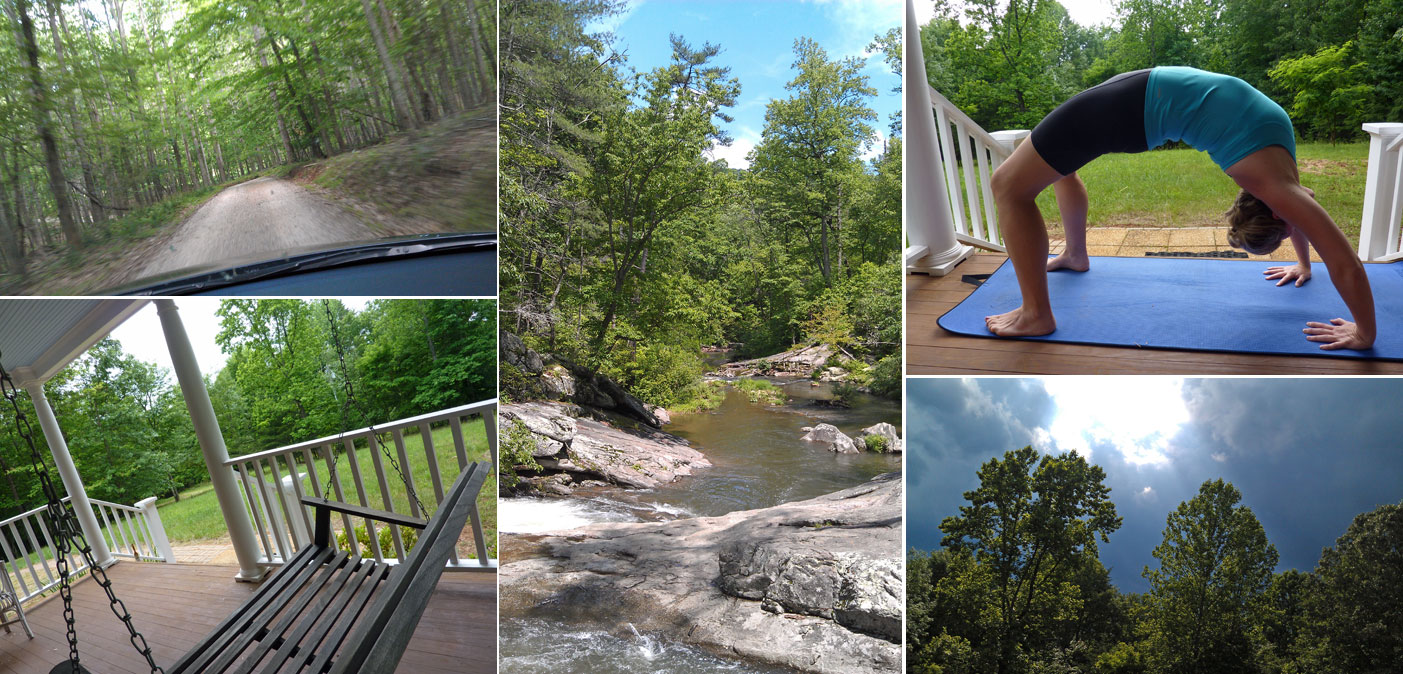
Clockwise from bottom left: Front porch swing, gravel road leading to house, local swimming hole, morning yoga, and afternoon storm clouds
After our week-long stay in Maine and a weekend stop in Portsmouth for our friends’ wedding, we’ve made our way to a friend’s house in the mountains of central Virginia. In a happy scheduling coincidence, our friend (who travels frequently) happens to be at the house for the first week of our planned three-week stay. It’s been nice catching up with him over shared meals and late night card games, and it will be nice to find a rhythm of our own once he’s on the road again. We arrived late Sunday night and have spent the week becoming familiar with the area and our new temporary home. The house is set back about a mile down a gravel road, with few neighbors to encounter and many acres of woods to explore. Each morning, I’ve taken my coffee outside and listened to the land come alive from my perch on the wooden swing. We’ve napped in hammocks and walked along winding paths. We’ve witnessed deer grazing in the front yard, turkey vultures and coyotes scavenging along the main road, and countless birds and butterflies and bats and other things with wings. We’ve also managed to keep our fitness routine somewhat intact, with some creative adjustments. When the weather’s been nice, we’ve brought our workouts to the back yard, and when it was raining, I set up my yoga mat on the covered front porch. We’ve explored sections of the Blue Ridge Parkway and hiked to a remote waterfall swimming hole. Today, we ventured to the next county in search of a safe running route and ended up finding a converted rail trail that was perfect for today’s training run. (We’re running a 10K here in Virginia on Saturday, and it’s been a little tough keeping up our mileage on the road.) We’re now back at the house, enjoying a quiet afternoon and watching storm clouds roll in from the west. I think it’s going to be a good night to hunker down on the mountain. -J
Home Sweet Home…For Now
After a whirlwind two weeks (and two especially long days of driving), we are back home tonight, looking forward to sleeping in our own bed and having breakfast tomorrow at our favorite cafe. Two days ago, we left 80-degree sunshine behind in the Florida Keys. This afternoon, we met friends of ours (in town from California) for drinks in chilly New Hampshire, rolling in to the bar directly from the highway. In order to make it on time, we logged our longest day of driving to date yesterday–817 miles from Savannah, GA to Yonkers, NY–adding to the trip total of 4,073 miles. Sal the Subaru was a champ on his first long-haul road trip, averaging more than 25 miles per gallon (fewer in the mountains than in the South). Our words per gallon fared only slightly better, due largely to the lack of downtime we built into the schedule. It’s something we plan to include more of in our longer trips later this year, but our priority for this one was simply to get far away from here and physically break away from our prior day-to-day lives. Now that we’re back, somewhat rested and fully reinvigorated, we have a long list of posts, photos, and videos to write, edit, and upload. We’ll spend most of April at home, writing, running, and finding a new rhythm. But before March ends, we have one more adventure planned: to participate in a charity trivia bee tomorrow night. After several days on island time, it will take a lot of focus and some strong coffee to ensure our brains are up for the challenge.
Setting Our Watches to Kairos Time
On Saturday morning, we drove to downtown Tampa to meet a friend and mentor of mine, Janet, for coffee at a local place called Sophie’s French Café and Bakery. We were near the University of Tampa, and there was an arts festival in progress on the same street as the café. We sat at a table among the eclectic collection of mismatched chairs and tables and caught up on life, writing, family and travel. We also discussed plans for a visit later this year during which J and I will help Janet move her belongings back to New England to start a new job.
While telling Janet about our plans to travel and write for the upcoming 12 months, I mentioned that since leaving my job I’ve had a hard time remembering what day it is. Janet responded, “You’re on mythic time now. You’re living in the moment on Kairos time, instead of by the clock on Chronos time.” Her statement stayed with me over the past couple of days, as many of Janet’s observations have, and last night I started doing some research into the concept of “mythic time.”
Chronos is the Greek word for chronological or sequential time. This is the time of clocks and calendars, and the time that most of us exist in during our day-to-day lives. Kairos is the Greek word for mythic time, or those periods where time seems to evaporate: creative spells, long runs, meditations, getting lost in a task, etc. Further research into Kairos revealed that the term can be translated as “the supreme or opportune moment,” a moment where one must choose to act in order to take advantage of an opportunity in front of them. A closely related phrase is Carpe Diem, typically translated as “seize the day.”
I also read that the Greeks believed that mythic time was the time during which the gods lived out and recorded their stories. These stories were emblazoned on the wheel of time as lessons for humans, and then the wheel was set into motion, forming Chronos time. The metaphor of living our life on mythic time, completely in the moment and taking advantage of opportunities as they emerge, is beautiful to me. This year will be a time for J and me to live out and emblazon new stories and experiences onto our past, new myths and lessons for how we will live our future together…whatever it will be. -M
To Hike or Not To Hike: Thru-Hiking the Appalachian Trail
“The mountains are calling and I must go.” –John Muir
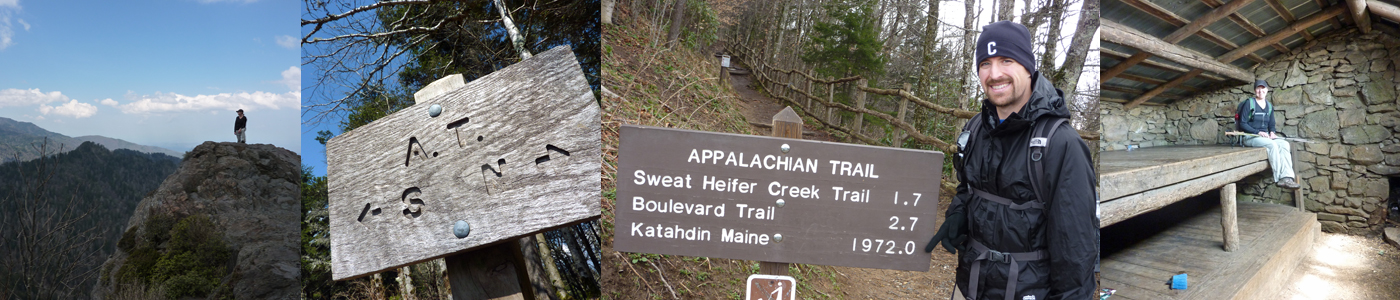
Hiking the AT (L to R): Atop Charlie's Bunion--Directional signage--2,000 miles to Maine!--Icewater Springs shelter
More than once, the idea of thru-hiking the Appalachian Trail (hiking it from end to end) has crossed my mind. Three or four months of solitude in the woods didn’t sound so bad, hiking beautiful mountains and clearing my head while I explored the world on my own two feet. We’ve hiked short stretches of the AT in several states, including the Jackson-Webster loop in New Hampshire, and on this trip so far, our 10+ miles in Tennessee and Virginia. While I’ve enjoyed each of those day hikes, with every mile I log, I wonder if I’m really up for 2,000 more. And then we chatted with a few guys who were in the early stages of their thru-hike attempts, and I wondered why I ever entertained the idea in the first place.
The majority of thru-hikers tackles the trail in a northbound fashion, meaning they start their trek at Springer Mountain, Georgia and walk in a general northeasterly direction until—approximately 2,180 miles later—they reach the end of the trail on the summit of Mt. Katahdin in northern Maine. The journey takes the average hiker four to six months, although some take three and others take more. The trip is generally constrained by weather, since most hikers need to make it to Maine before it gets snowed in. In a less popular route, some hikers start at Katahdin in May or June and finish in Georgia in autumn.
The Park Service strictly regulates thru-hikers and backcountry camping. To minimize impact on the trails and ensure a level of traceability, hikers are required to stay overnight in designated shelters. There is a network of shelters (maintained by the Appalachian Mountain Club and other organizations) that offer protected lodging and are spaced roughly a day apart on the trail. Backcountry tenting is prohibited, and ridge runners (volunteers who run back and forth across segments of the trail) patrol the ridge to enforce that rule.
The shelters are beautiful buildings, often made of stone and timber. But what they offer in beauty, they lack in comfort. At the Icewater Springs shelter we checked out, the bunks consist of two large wooden platforms, one about two feet above the other. Hikers (mostly thru-hikers, with a few day hikers thrown in for good measure) sleep shoulder to shoulder, often with strangers, in the three-sided structure.
We encountered several thru-hikers on the trail yesterday. Most were men, hiking alone, ages ranging from early 20s to mid-60s. We saw only one couple and one solo woman, likely in her 40s. As a general rule, they were a chatty bunch, not afraid to strike up a conversation or ask a question. We heard tales “vermin” in the shelters and of guys like “Machete Mitch,” a survivalist type who is hiking parallel to the AT (but not on it) equipped with only a machete, a compass, and an iPad. (Apparently survivalist does not mean electronics minimalist.)
The “vermin” didn’t sound too exotic…mostly field mice and chipmunks looking for food…but in my mind, even a chipmunk becomes terrifying if he’s running across my face in the middle of the night. Then there’s the incessant snoring from your neighbor, and if you’re extra lucky, a crying baby like one hiker reported from a shelter in the night before. (Parents: I understand the desire to take your kids into the backcountry overnight, but can we agree to wait until they are potty-trained?)
And while the majority of the AT does cross scenic ranges in sparsely traveled places like those I imagined, some sections cross right through major tourist areas or the centers of towns. One hiker shared the culture shock he experienced when he hitched a ride into Gatlinburg after two weeks on the trail…and was dropped off near a Hard Rock Café. Not exactly the scenery of Muir.
I have total respect for folks that attempt a thru-hike, tackling a strenuous journey and relying only on themselves while they attempt the adventure of a lifetime. Most sources estimate only 1 in 4 hikers who start the hike will finish it. I, however, have a 0% chance of finishing it, because I will never start it. But I will go to the mountains when they call, and I will return to the AT. I’ll just continue to seek out my adventures in metered doses, in 10-mile sections that can be covered in one day. -J
Some Drives Are Better Than Others
Skyline Drive traverses the Blue Ridge Mountains through Shenandoah National Park. The north end of the drive begins in Front Royal, VA, a surprising town that appears to be maintaining itself quite well despite the economy. The architecture in Front Royal is familiar, each building crafted of the same stones, bricks and shingles of eastern towns ranging from Plattsburgh, NY to New Castle, PA to Greenville, SC. It is the architecture of hardware stores and insurance agencies, small public libraries and aging churches. We agreed Front Royal would go on the list of potential places to live “someday.”
At the entrance to Skyline Drive, Howard, the friendly, nervous, red-headed (and bearded) ranger, sold us our $80 Interagency Annual Pass, allowing access to the many places we hope to visit across the country in the next twelve months. Armed with our pass and some park literature, we hit the road. Skyline Drive is 105 miles of winding, rising and falling road filled with wildlife, old growth forest and very few other people. (Most park facilities don’t officially open for the season until later this spring.) After getting distracted by a handful of deer, two overlooks and countless circling hawks, it had taken us nearly 20 minutes to go the first five miles. It was looking like the drive would take longer than the three hours we had estimated. (The maximum speed limit on the drive is 35 MPH.) We were all smiles and in no hurry. Today, the deer posed for pictures, but despite our vigilance, the bears were elusive. Maybe we’ll be luckier in the Smokies…preferably from the car.
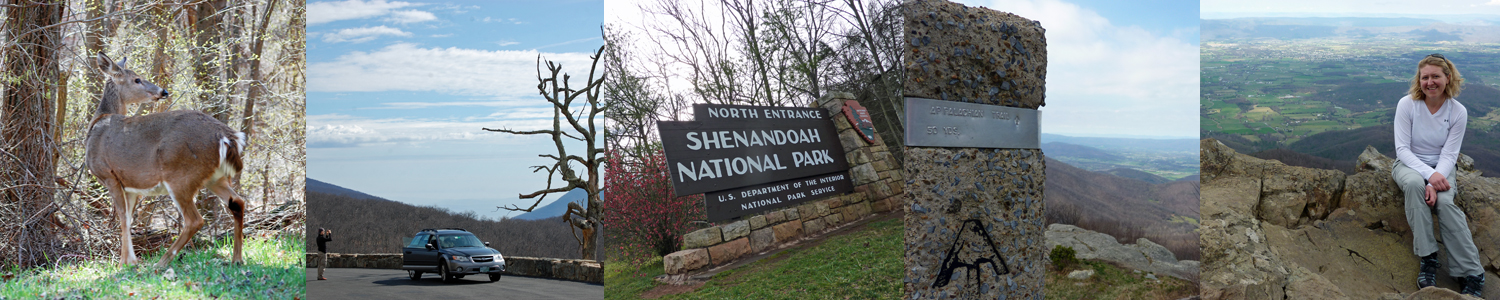
Today's Adventures (L to R): Wildlife-Scenery-North Entrance-The Appalachian Trail-Stony Man
At the halfway point of the drive, we parked and hit the trail for a short hike to the outlook on Stony Man Trail, recommended by the ranger as a brief but rewarding trip into the woods. At 4,010 feet, it is the second highest point in the park, and part of the summit route overlaps the Appalachian Trail. The trail was well-maintained, and we cruised to the top in 20 minutes. Once there, we surveyed the valley and took in a recommendation from a local couple to visit the “Camp David of President Herbert Hoover,” also in the park. We determined that this newly found part of America was worth a second visit and a much more thorough exploration of Shenandoah National Park. Perhaps later this spring…
The second half of the drive went more quickly than the first. At the end of the road, we opted to take the highway to Tennessee instead of the Blue Ridge Parkway. Although the Parkway is on our “must do someday” list, it wasn’t on our “must do this trip” list. We capped off our 415-mile day with a dip in the hotel pool and a tall draft beer. My first time in Tennessee has been more relaxing than expected. I’ll be enjoying the hotel bed tonight, since tomorrow night will bring the Great Smoky Mountains and our first campsite of the trip! –M
Here’s a look at what we saw from the summit of Stony Man:
The Rear-View Mirror
So…I resigned from my job at the company I’ve worked at for the past thirteen years. My last day will be this Friday. After that, we’ll pack the car, hit the road and start a different kind of work, moving our lives in a new direction. I mentioned in a prior post that I expect some friction as I wind down over the next couple of days. That’s okay. There was plenty of friction in my day-to-day job anyway. As I sit in my kitchen and reflect on the job and people I’m leaving behind, I also know that I’ll receive encouragement and support from many of my friends and coworkers. Delivering my resignation turned out to be far less dramatic than I expected (probably because I was wrapped up in my own head about it). I’m guessing the next two days will turn out the same way, and I’m relieved by that thought. I’m grateful for the good people who I’ve worked with over the years, and I’m confident that the team I’m leaving behind will be successful . After Friday, the only employee I’ll be responsible for is me. I think I’m up for the challenge. – M
 Words Per Gallon