Exploring the world one word…and one mile…at a time

Latest

4th of July, Leipzig Style

image

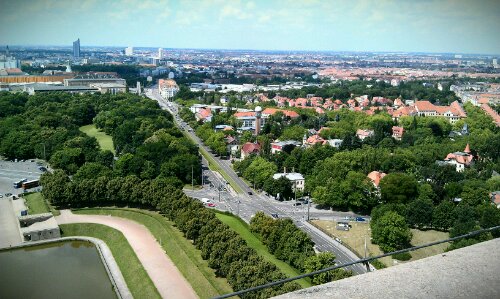
We’ve been in Europe for over a week now and have yet to post an update. Not for lack of things to talk about, but more for lack of time to write and infrequent internet access.  Tonight, in Prague of all places, we have free Wi-Fi at the hotel and are back in our room at a reasonable hour. So a quick update!  We’ve had a series of amazing adventures since arriving in Germany last week, beginning with three days of family festivities surrounding M’s cousin’s wedding.  We attended the civil ceremony at the town hall, or Rathaus, and the church ceremony in Aschaffenburg, where M read a passage in German during the service.  There was also a garden party in the rain, complete with an outdoor viewing of the Germany-Italy semi-final game of the Euro Cup and plenty of strong beer.  We next explored Berlin for two days before meeting up with M’s cousin, C, and his wife, S, at their apartment in Leipzig.  After we logged an early training run through the park yesterday, C and S showed us around town, including a huge monument to the 1813 War of Nations battle at Leipzig (Google it…).  We wandered around the university area and stopped at some of their favorite pubs and bookstores.  At the monument, we climbed to the top for a view of the city, but the picture here doesn’t do the experience justice.  We made our way back to their apartment and capped off our non-traditional 4th of July with a balcony barbecue of tofu curry wurst and grilled gouda and hours of conversation in at least two languages.  It was a fantastic evening to close a perfect day.  We didn’t even miss the fireworks.

European Vacation Part Deux

image

After six months of anticipation–having booked our flight back in January–we are waiting patiently in Terminal E at Logan for our outbound flight to Frankfurt via a short layover in Dublin. The clouds are rolling in, but we are hoping for an uneventful departure. We will arrive at our first destination (M’s uncle’s house in the small town of Grosswallstadt) sometime tomorrow afternoon. Our initial few days in Europe will be filled with celebration…first of M’s cousin’s wedding and then of the finals of the Euro Cup, which we hope to witness from Berlin’s famous Fan Mile. After a few days exploring Berlin and Leipzig next week, we plan to roll east through Dresden on our way to Prague, where we will explore a city new to us both. We are excited and honored to be sharing in T’s and S’s wedding festivities, and we are equally excited to be embarking on another leg of our journey together. We hope you will join us on the other side…of the Atlantic!

It’s a Marathon, not a Sprint

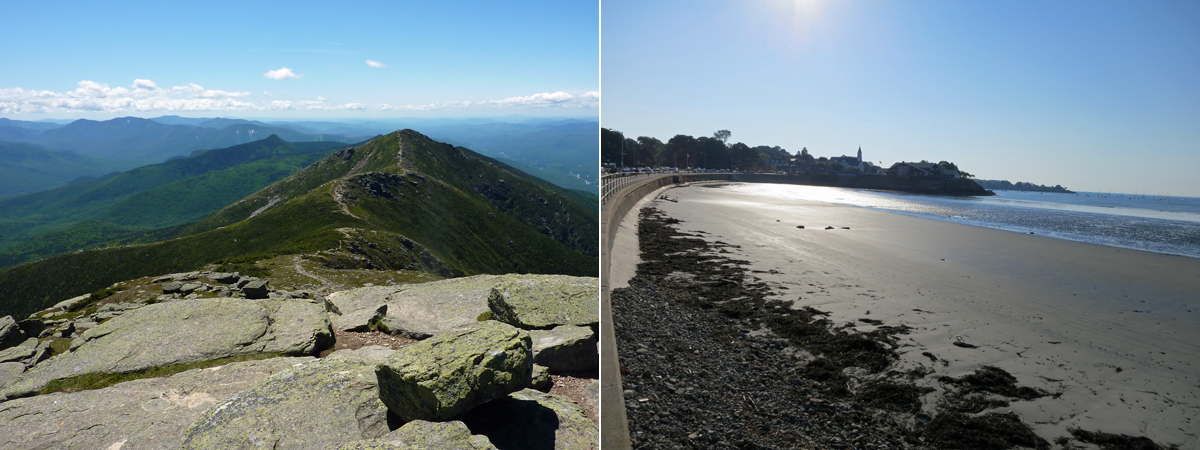
My training locations so far.  Week 1–Hiking the Whites.  Week 2–Running along the Atlantic.

Since we’ve started our travel blog, a pattern has emerged with the timing of our posts:  First, we hit the road, blogging three to five times per week about our trips.  Then, after a few weeks on the road, we return to New England and go quiet for a while.  Our silence is usually because our time in New England is filled with chores, errands, and visits with family and friends.  It’s not all fun and games, though…someone has to wash my stinky running gear!

We followed this same pattern after returning from our last trip to Virginia and Tennessee.  Now that we’ve been back in New England for a couple of weeks, it seemed about time to get back on the wagon and get some new posts published.  Of course, we leave for Europe next week, which should make for much more interesting posts than picking up dry cleaning, going to the bank and organizing our gear in storage.  Stay tuned!

For now, I wanted to put a little context around an activity that will color all of our upcoming travel for the next few months.  Running!  I know…I know…how is this different than any other trip?  Well, it’s time for marathon training!  It’s almost the end of Week 2 of my 18 week training plan for the Mount Desert Island (MDI) Marathon in Maine.  The marathon is Sunday, October 14th, just a couple of days after my birthday, and we’ll be spending the weekend in Bar Harbor for the event.

The race is an important milestone for me, since it will be my first marathon since I started running in late 2009.  In addition, it takes place in a location that is very important for J and me.  We got married on Mount Desert Island in Northeast Harbor in 2011, and (as you may know from some of our prior posts) we returned to the area this year to celebrate our first anniversary.  Not only is MDI beautiful, but it carries a huge amount of sentimental value.

Anyone who has run a long race or marathon before knows that you don’t just show up to compete.  You have to train.  And anyone who knows me knows that I like to train hard.  It’s rare for a race to go by where I haven’t set and trained for an aggressive time goal (aggressive for me anyway), and the MDI marathon is no different.  I’m pushing to finish the race in under 4 hours, with a target pace of 8:30 to 8:45 per mile.  I’ve run faster than this in prior races, but never anything longer than a half marathon.  Also, in addition to being voted the most scenic marathon in America and runner-up for best overall marathon, the MDI marathon is hilly.  One blogger who ran the race reported his GPS watch showing 1,700 feet in elevation gain over the 26.2 miles and just as much in elevation loss.

I’m loosely following a Hal Higdon training plan.  Higdon is a widely respected runner and author who has been helping runners succeed longer than I’ve been alive.  I chose his Novice 2 plan, since it is a little more aggressive than Novice 1.   I’ve not run a marathon before, so I stayed away from the intermediate training plans.  In a nutshell, the plan increases your training mileage and the length of your longest weekly run week-over-week for 18 weeks leading into the race.  There are some lower mileage weeks built into the plan for recovery after the longest of the training runs, and a taper period (period of rest and recovery) for the two to three weeks leading into the race.  The plan also designates the pace of each run, with several runs being completed at the desired marathon race pace (“at pace”).  The longest training run on the plan is 20 miles, and for me it will take place in late September about three weeks before race day.

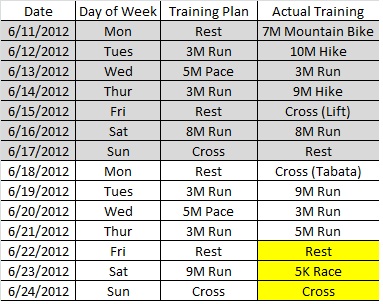
So far, my adherence to the structure of the training plan has been less than perfect.  I have gotten in all of my training, but it has required some substitutions and schedule changes due to travel and other activities.  Here’s how Weeks 1 and 2 have gone so far, with the yellow representing what’s left this week: 

I moved my long run up this week because we’re running a 5K race on Saturday (part of our goal of running a race per month in 2012).  I also substituted some hikes for runs in Week 1 because we were in the White Mountains and the weather was fantastic.  I was comfortable with these adjustments in the early weeks of the plan, since the mileage is in my comfort zone of 15 to 25 miles per week.  As the plan continues, I need to buckle down.  Given the demands of the plan, I don’t want to risk injury due to over-training .  Also, since the plan is designed to provide enough rest leading into the longest run of the week and enough recovery after, it’s important that I stick to the prescribed schedule to avoid getting hurt or falling short on the important long training runs.

This will make for some scenic, interesting and challenging runs in upcoming Weeks 3 and 4, since I’ll be traveling in Germany and the Czech Republic!  We will be visiting with family and friends for my cousin’s wedding before taking the train to Berlin, Leipzig, Dresden and Prague.  I’m looking forward to seeing more of Europe, practicing my less-than-stellar German and, of course, logging some international marathon training miles! – M

Traversing Tennessee

Sunday’s Scenes (L to R): Kingsport’s old train depot and Main Street, plus Knoxville’s Market Square and a tasty brunch at Cafe 4.

After two weeks in the Virginia mountains, we hit the road yesterday with the goal of picking up a few more “new” states and national parks before we head back to New England for a while.  We spent Saturday night in Kingsport, a small manufacturing city in northeast Tennessee we first discovered on our March road trip.  Upon arrival, we made full use of the hotel’s fantastic gym, indoor pool, hot tub, and restaurant.  This morning, we drove to the Kingsport Greenbelt, a recently-completed mixed-surface fitness trail that traverses nearly ten miles of the town.  We were a bit surprised by the hilly terrain, which was a change of pace (literally) from the flat rail trail we’d run a few times in Virginia, but the pleasant scenery helped the time and miles pass.  We completed an enjoyable 4-mile run before heading back to clean up and repack the car.  We took a driving tour of downtown and then hit the highway to conquer the remaining stretch of I-81.  We picked up I-40 into Knoxville, home to the University of Tennessee, where we made a spontaneous decision to take a break and check out the downtown area.  We parked in a city garage (free on Sundays!) and wandered around a bit before deciding on a place to eat.  We enjoyed the weather and the people-watching as we ate a late outdoor brunch in Market Square.  We picked up coffee for the road before driving the last leg of the day down to Chattanooga, on Tennessee’s southern border with Georgia.  Chattanooga was featured in a magazine article we read last year as the best place to live for outdoor enthusiasts, and it’s been on our list of places to check out ever since.  The weather is looking stormy tomorrow, so we’re off to study the hourly radar with the hopes of picking the right hour for a running tour of downtown…  -J

Putting Charlottesville to the Test

We started our day today just outside of Charlottesville, VA (C’Ville) at Thomas Jefferson’s famous home, Monticello.  The rain held off as we walked through the gardens and took in the view.  As we toured the home itself, the place that Jefferson loved more than any other, a quote from Jefferson about his home struck me.  “I am as happy nowhere else and in no other society, and all my wishes end, where I hope my days will end, at Monticello.”  This is how I want to feel about the place that I live, at least most of the time.  It should be enriching and inspiring, while providing a venue for both the social and recreational activities I enjoy.  I don’t think that’s too much to ask.

Scenes from Monticello (L to R): J in the Garden Pavilion, extensive vegetable gardens, the main house, gravestones with a story and a view

In addition to exploring ourselves, the United States and the National Parks, one goal of our road trips has been to seek out places that we someday may want to live. Each new city or town we enter goes through a review process either openly or in our minds.  All locations are ultimately compared to the New Hampshire Seacoast.  Why the Seacoast?  Aside from it being our current home and a familiar place, it has several characteristics that we look for in a home base:  Not too crowded and not too rural (our ideal is somewhere between 8,000 and 100,000 people), great places too run (long roads with low traffic, low risk of crime, beaches and/or bike trails), an arts/music/literary scene, and a downtown with quality independent restaurants and coffee shops.  Our current hometown has most of these characteristics, but given our recent freedom, we enjoy entertaining the idea of moving to new places.

One mistake we’ve made during our travels is to build up new places in our minds before actually visiting them.  No town is perfect, and unrealistic expectations can ruin a place before even getting there.  The first example of this for us was Portland, Oregon.  We had built Portland up to be the ideal place to live: progressive, artsy, West Coast (sort of)…it sounded perfect.  When we arrived in Portland, it was raining, gray, cold, filled with homeless people and nothing like the place we wanted it to be. Although we eventually grew to like Portland, we were disappointed by its inability to live up to our escapist/utopian expectations.  It’s easy to overlook the flaws in one’s hometown.  They are familiar, which by nature makes them less threatening.  The flaws in a new place stand out, especially when you haven’t imagined there would be any.

Before we came to Virginia, a friend recommended that we check out Charlottesville, home to the University of Virginia.  “You’ll like it,” she assured us.  We asked our host, B, about it, and he concurred, mentioning the pedestrian mall, Friday night live music, yummy pizza, etc. as highlights.  Despite the threat of severe storms, we left Monticello and continued to downtown C’ville, anxious to give it a look before we headed out of Virginia for a few more stops on this leg of our journey.

We started our visit with a walk hand-in-hand down the pedestrian mall, taking in the mix of independent and chain stores, shops and restaurants.  So far, so good.  We stopped at the most highly recommended pizza joint in town, Christian’s, for a slice and a local beer.  Lots of veggie options and definitely delicious!  We sat by the window and enjoyed our late lunch while watching the eclectic mix of passers-by:  business people, students, children, grandparents and homeless folks, and they all seemed right at home in this downtown center.  It’s a welcoming place. 

After lunch, we waited out a downpour in a used bookstore called Blue Whale Books.  We chatted with the cashier, a UVA poet, and picked up two used books for $2 (a biography of Rilke for J and an analysis comparing Jungian philosophy to Tibetan Buddhism for me).  We left the pedestrian mall and headed for a drive around the UVA campus where the academic buildings were right across the street from the coffee shops and pubs…my kind of town.

Snapshots of C’Ville (L to R): Orienting ourselves on Main Street, the rainy pedestrian mall, tasty pizza and beer, and the UVA campus

The final test for C’Ville, and any town, was the grocery store.  As vegetarians who do our best to cook and eat healthy, local, organic food whenever possible, the quality of the grocery store is a key factor in determining the livability of a city or town.  When it comes to grocery stores, a town with a Whole Foods is pretty much a sure thing.  With the exception of higher prices, Whole Foods is like a candy store for vegetarians.  It’s a place to buy the specialty items that most grocery stores don’t carry. Tack on a weekly supplemental trip to a regular grocery store for staples and a farmer’s market for seasonal items, and you’ve got everything you need.  The C’Ville Whole Foods was clean, bustling and close to downtown, rounding out the Words Per Gallon livability checklist.

So how did C’Ville stack up?  We could definitely see ourselves living there.  For now though, there are so many other towns to explore, more roads to run on and more National Parks to visit.  Plus, our new place on the Seacoast beckons; it will be ready later this summer.  Maybe we’ll move next year… -M

Modern Self-Reliance

L to R: Storm clouds rolling in, M clearing debris by the fallen tree, this morning’s aftermath

During these early days of our journey, I’ve spent more time being active and less time relaxing than I thought I would.  Although I love reading, it’s hard to curl up with a good book when there is a mountain to climb or a town to explore or a recipe to invent.  This week I finally managed to spend a few evenings reconnecting with the likes of Thoreau and Emerson.  I laughed out loud rereading the introduction of Walden two nights ago, pleasantly surprised (again) by the relevance of some of his statements 150+ years after he wrote them.

Thoreau’s contemporary, Emerson, had a few relevant passages of his own in the 1841 sleeper Self-Reliance, which I’ve also flipped through recently.  To Emerson, self-reliance meant things like individualism and non-conformity and authentic inconsistency.   To me, this week anyway, self-reliance means problem-solving even when we don’t have complete information.  It means knowing how to read a map (and further, actually possessing one) when we’re off the grid and GPS can’t help us.  It means getting creative with where and how we workout when our usual running routes are hundreds of miles away.  And last night, it meant summoning all of my introverted courage to make a cold call to a person I’d never met asking them to help me.

Why did I need a stranger’s help?  First, let’s back up to last week, before our friend left town.  Just before heading to the airport, B filled us in on some need-to-know info about the house, practical stuff like where to find dry firewood and where to drop off the recycling.  He also mentioned the closest neighbors, Mr. and Mrs. H, saying he wished he had time to introduce us to them before he left, but alas, that hadn’t worked out.  So instead, we just got a passing reference to their existence, at which point for whatever reason, I catalogued their names in my brain.

There are only five houses on this gravel road, all set back into the woods and separated from each other by 1/3-mile sections of forest.  We pass three driveways on the way to B’s house, but we can barely see the houses, and we’ve never seen another car on the one-lane road.  Mr. and Mrs. H live just past B’s house, but we can’t see their house either.  Occasionally we hear car wheels crunching over the gravel.  Most folks in the area keep to themselves, and it was unlikely we’d run into any of the neighbors during our stay.

Then last night, after two days of self-imposed exile on the mountain, M and I headed into town for dinner.  We knew a line of thunderstorms was pushing through the area, but we weren’t too worried.  Rain’s rain.  We made it to dinner and almost back to the house before the first drops hit the car.  We assumed the storm was just arriving.  Then we noticed several branches and clusters of leaves on the road ahead of us.  “Looks like the storm already blew through here,” M commented.

We continued toward the house, through the series of dips and turns, before stopping to remove a large branch from the road in front of us.   Only after getting out of the car did we notice a giant tree down, blocking the entire road, about fifty feet ahead of where we stopped.  We walked closer to inspect things.  There was no way around the tree, no lights visible at the nearest neighbor’s house, and the rain was picking up.  The storm was just getting started.

We decided to back track to the main road where the tree cover was less dense, thinking that if one giant tree could fall, so could another.  We drove the five miles or so back into town and waited out the storm in a pharmacy parking lot (where there was cell service).  As rain pelted the car, we contemplated our options.  We could drive back to the tree, park the car, and walk (in flip-flops, of course) the remaining half-mile to the house to pick up B’s chainsaw, which (a) he warned us wasn’t top notch and (b) neither of us had used before.  We could find a map and see if we could locate an alternate route to the house, perhaps on a connecting back road.  Or we could try to flag down one of the neighbors for help.

For context, at my core, I am slightly awkward introvert who can go weeks happily without interacting with another human.  So the idea of blindly ringing someone’s doorbell is a paralyzing thought.  Making a cold telephone call is a close second, but it beats the in-person interaction.  So from the depths of my brain, I recalled Mr. and Mrs. H’s name and used the internet connection on my phone to look up their telephone number.  There were eight H’s in town, but only one on the right road.  With that find, I summoned all of my introverted courage and dialed the number.

After a mildly strange introduction to the tune of “we’ve never met, but I’m staying at the house next door and is there any chance you know of another way into the neighborhood because there is a giant tree blocking the road and we can’t get home.”  Mrs. H, who answered the phone, wasted no time in understanding my rapid Yankee speech and said, why, yes, there was a back road, but she wasn’t sure what condition it was in and the car might get all scratched up if we attempted to use it.  After a minute more of conversation and a brief chat with her husband, Mrs. H said that Mr. H would grab his chainsaw and meet us by the tree in a few minutes.  Sweet relief!

By the time we arrived back at the tree, Mr. H was busy at work.  We left the headlights of our car on to shed some light on the situation.  Mr. H quieted the chainsaw when we got out of our car and approached him.  “You said it was a tree, but I had no idea it was going to be this big of a tree!” he said with a laugh.  We exchanged handshakes and greetings and then looked up and up, to about 30 feet off the ground where it looked like lightning struck.  Half the tree was still standing, splintered at its wounded top, and the other half—an additional thirty feet or so of it—was on the ground, blocking the road from side to side.

After another minute of talk about the weather and how we knew B, Mr. H got back to work, cutting off branches and limbs before tackling the thin upper part of the tree.  While he figured out the best way to fillet the thick main trunk of the tree, M and I got down to work, moving the parts and pieces and stumps and logs to either side of the gravel road.

The whole task took about 15 minutes, a feat only possible because of Mr. H’s chainsaw.  As it turned out, Mr. H was grateful he found out about the tree on a Tuesday evening and not on Wednesday morning as he was leaving for work or his kids were trying to get to school.  He would have had to do the work either way, and better to know about it in advance and have a little help.  We were grateful for his help and his power tools.  Sometimes self-reliance means wielding the chainsaw yourself, and other times it means calling someone with a bigger chainsaw to help you.  -J
From Farm to Table…via Lynchburg

Our Virginia adventures continued yesterday with a day trip into Lynchburg.  A few weeks ago, while still back in New Hampshire, we had sought out and registered for a 10K race downtown.  We have a goal of running a race every month this year, and due to our travels, a Virginia race best fit our schedule for May.  Neither of us had been to Lynchburg before, and running the race was a great way to see part of the city.  (You can read my full recap here if you’re interested…)

After the race, which had an early 8 AM start, we did a quick change of clothes at the car (tucked into a shady spot in a free parking garage) and walked several blocks down Main Street to the Lynchburg Community Market.  We planned to fill a bag with fresh local produce, but first things first…specifically, breakfast.  We assumed the long line at Barb’s Dream Hut inside the marketplace was a good sign, so we ordered veggie omelets and shared a side of hash browns.  We also ended up sharing our table with a local couple in their late 70s.  They were newlyweds, having just tied the knot last December, although their first date was actually 63 years earlier, before he introduced her to his best friend…whom she subsequently married.  It was a sweet story and part of a lovely conversation.

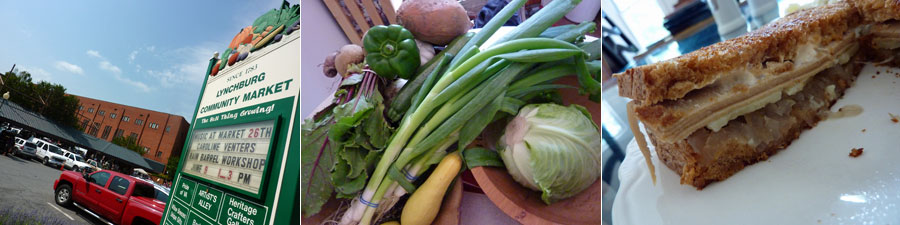
After breakfast, we wandered around the indoor market, picking up some Vidalia relish and locally roasted coffee before hitting up the farm stalls outside.  We loaded two shopping bags with onions, peppers, squash, cabbage, beets, sweet potatoes, and kale, plus a loaf of fresh bread and a tub of sun-dried tomato goat cheese.  As is typical for farmers markets, we paid a lower-than-usual price for produce fresh from the producers’ trucks and a higher-than-usual price for artisan breads and cheeses.  For us, this is a fair trade-off, allowing us to support the local economy (wherever we are) and satisfy our own desires to know what we are eating and how it was made.

L to R: Lynchburg Community Market, the day’s bounty, grilled deliciousness

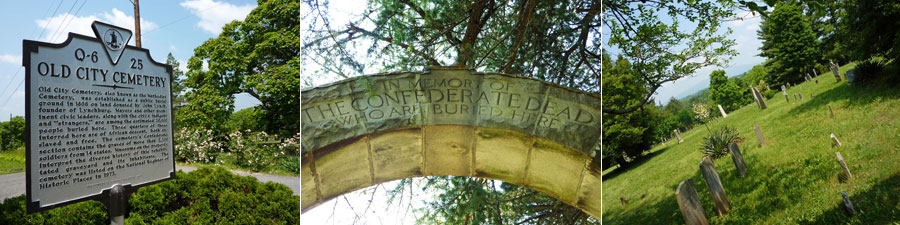
We left the market and walked back to the car, stashing our goods before driving over to the Old City Cemetery.  The cemetery is more than a burial ground, as it contains five small museums paying homage to Lynchburg’s role in the Civil War and the railroad’s role in Lynchburg’s history.  Lynchburg’s location on the James River and at the convergence of three major railways led to its establishment as a major hospital site during the Civil War.  The cemetery is filled with history, including the graves of more than 2,200 Confederate soldiers and numerous early cultural and political leaders from the region.

L to R: Historical marker, engraved arch, serene grounds

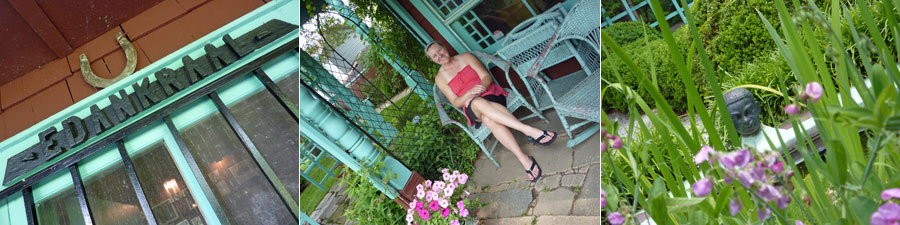
Our next and final stop in town was the Anne Spencer House for a visit to her garden.  Spencer was a poet and part of the Harlem Renaissance of the 1920s.  Her house is part of the Pierce Street historic district (one of seven historic districts in Lynchburg), and the garden has been lovingly restored by a local non-profit group.  It is open to the public from dawn to dusk, and we found ourselves alone there on a sunny Saturday afternoon.  We wandered the garden paths and sat in chairs outside Edankraal, the writing cottage her husband built for her so she would have a quiet place to write and be inspired by the beauty of the garden.  The garden is filled with history, both in the stories of significant visitors that stayed there and in the plants and flowers in the garden, many of which have persisted since the Spencers first planted them in the 1930s and 1940s.

L to R: Cottage signage, J on the porch, garden fountain (gift from W. E. B. DuBois)

On the way home, we talked about how we would love to have a cottage like Edankraal someday, a quiet place for writing and possibly for living.  For now, we are getting used to writing and living wherever we find ourselves, which this week is at our friend’s mountain retreat.  After the short drive back there, we unloaded our bounty and got down to the business of making the most amazing grilled sandwiches using the fresh bread, onion relish and goat cheese.  We capped the day by heading up to the second-story deck to watch the sun set over the mountains, thankful for a perfect day and the opportunity to explore places like Lynchburg. –J

Home is Where The Car Is

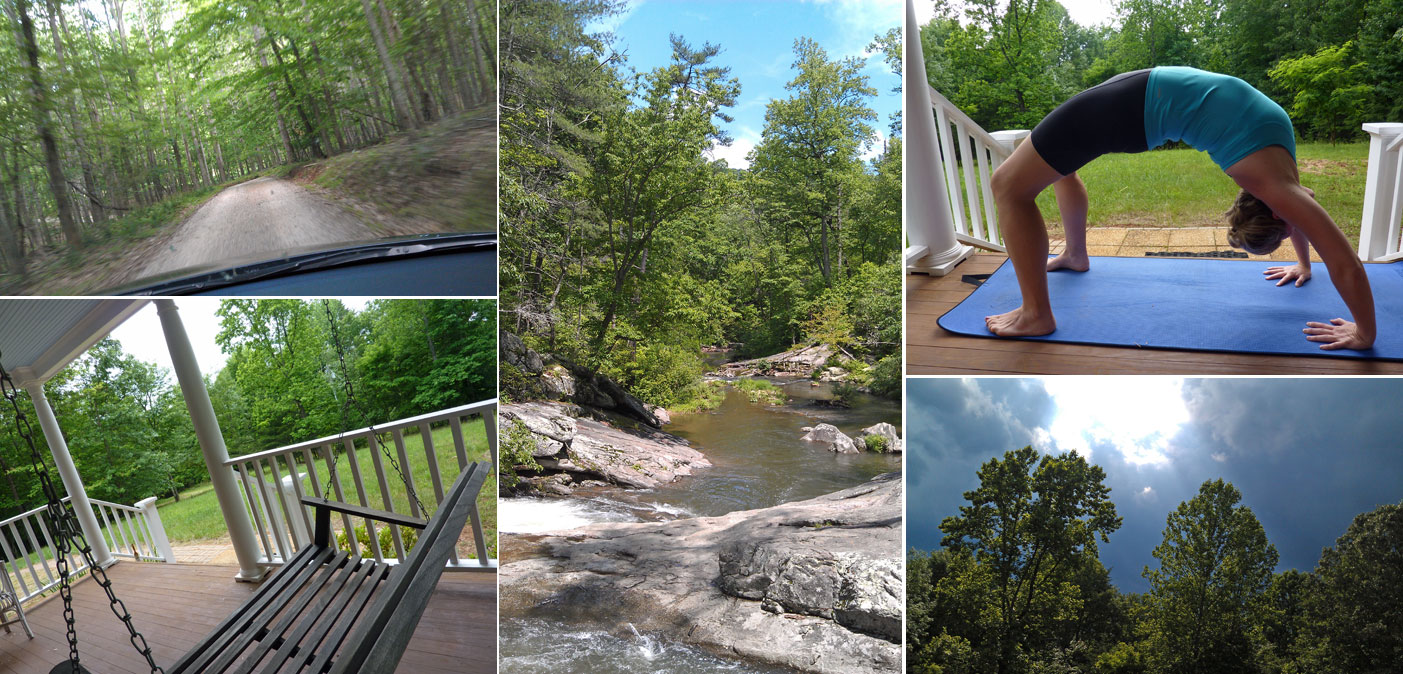
Clockwise from bottom left: Front porch swing, gravel road leading to house, local swimming hole, morning yoga, and afternoon storm clouds

After our week-long stay in Maine and a weekend stop in Portsmouth for our friends’ wedding, we’ve made our way to a friend’s house in the mountains of central Virginia.  In a happy scheduling coincidence, our friend (who travels frequently) happens to be at the house for the first week of our planned three-week stay.  It’s been nice catching up with him over shared meals and late night card games, and it will be nice to find a rhythm of our own once he’s on the road again.  We arrived late Sunday night and have spent the week becoming familiar with the area and our new temporary home.  The house is set back about a mile down a gravel road, with few neighbors to encounter and many acres of woods to explore.  Each morning, I’ve taken my coffee outside and listened to the land come alive from my perch on the wooden swing. We’ve napped in hammocks and walked along winding paths.  We’ve witnessed deer grazing in the front yard, turkey vultures and coyotes scavenging along the main road, and countless birds and butterflies and bats and other things with wings.  We’ve also managed to keep our fitness routine somewhat intact, with some creative adjustments.  When the weather’s been nice, we’ve brought our workouts to the back yard, and when it was raining, I set up my yoga mat on the covered front porch.  We’ve explored sections of the Blue Ridge Parkway and hiked to a remote waterfall swimming hole.  Today, we ventured to the next county in search of a safe running route and ended up finding a converted rail trail that was perfect for today’s training run.  (We’re running a 10K here in Virginia on Saturday, and it’s been a little tough keeping up our mileage on the road.)  We’re now back at the house, enjoying a quiet afternoon and watching storm clouds roll in from the west.  I think it’s going to be a good night to hunker down on the mountain. -J

Disconnecting for a Few Days…

We’re going off the grid for a few days, camping and hiking in the woods of Acadia.  We will update our Twitter feed (which you can see on the right side of this site) when we can, but we probably won’t do a long post again until this weekend when we roll back into New Hampshire for our friends’ wedding.  Hope you all have a great week!

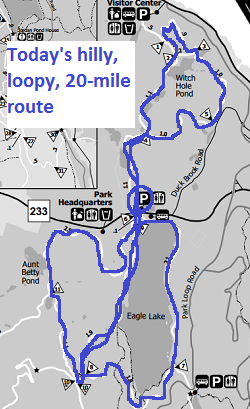
Milestones and a 20-Miler

It’s been a week of milestones: selling the house, hitting 50,000 miles with Sal the Subaru, and today, celebrating our anniversary.  Last year, we snuck away to Bar Harbor to get married, and this year, we returned to town to celebrate the conclusion of a crazy first year while kicking off a new one.  We’re staying in the same room at the same inn, one with delicious breakfasts and cozy beds, and we’re enjoying the relative calm of a resort town before the summer season begins.  The weather has been perfect these past two days, and since we’re expecting rain later this week (while we’re camping, of course…), we’ve been playing outdoors every day.  Today’s adventure was a 20-mile bike trek across two loops of the carriage roads we hadn’t done last year, plus one we had.  We left from the Eagle Lake parking lot and headed north around the Witch Hole Pond loop.  It was an easy, rolling start to the day, followed by a moderate climb to some fantastic island views.  We then cruised back to the start of Aunt Betty Pond loop, a strenuous 6-mile section that managed to be uphill in both directions.  After returning via the Eagle Lake loop, we were sitting at 18.3 miles, so we pushed our tired legs a bit more to reach the 20-mile mark.  Along the way, I experimented a bit with video of our ride.  Maybe someday I’ll graduate to a helmet cam, but for now, I’m using a handheld one, which can be a little bumpy (so don’t watch if you get dizzy easily…).  The first clip was shot along a flat stretch and contains a brief narrative.  The second one is a bit longer, with very little narrative, lots of wind and a bit of speed.  I had the camera in my right hand, which is also my braking hand, so not my brightest move.  Hopefully the video gives a little insight into what it feels like to fly down a gravel mountain at 20-miles per hour… -J